

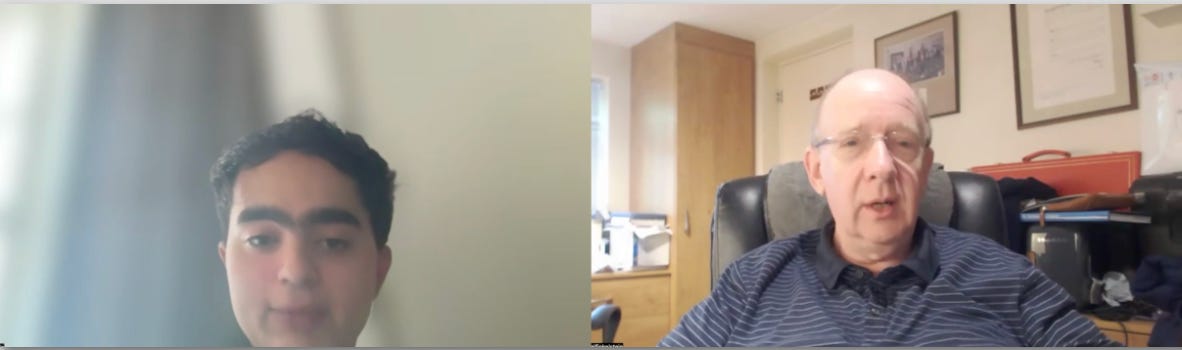
While my days leading OxfordSpeaks (the speaker society I founded in 2023 at Oxford) have sadly come to a close, I’m still lucky enough to be able to engage in the occasional interview. And a few weeks ago I was delighted to be able to interview Daniel Finkelstein. We discussed his powerful memoir, Hitler, Stalin, Mum, and Dad, which explores his mot
her’s family’s experience fleeing Nazi-occupied Holland (and later the Bergen-Belsen concentration camp) and his father’s harrowing childhood in Soviet-occupied Poland (and the USSR more broadly). Our conversation then moved to contemporary British politics and the recent rise in anti-semitism in the UK.
The book opens by following the story of Finkelstein’s maternal grandfather, Alfred Weiner. Weiner spent a lifetime dedicated to the pursuit of truth, and, in particular, defense of the Jewish community against anti-semitism as founder of the Weiner Library. He took part in the prosecution of the Bern Trial, which (successfully) exposed The Protocols as a fraud. Once Hitler came to power in 1933, the Weiner Library began meticulously collecting information about the Nazis and evidence of their crimes. This evidence would later be used in the prosecution of the Nuremberg Trials. While Alfred, his wife Grete, and his three children, including his daughter Mirjam (Daniel’s mother) moved from Germany to Holland before the outbreak of World War II, only Alfred was in London by the time the war started, leaving his wife and three children in Nazi-occupied Holland. Finkelstein recounts in harrowing terms his mother’s experience both in Nazi-occupied Holland and subsequently in the Bergen-Belsen concentration camp. To think such brutality took place only 80 years ago is one of the book’s most powerful reminders. While Finkelstein’s mother and aunts survived the Holocaust, the stories of other family members who did not are heartbreaking.
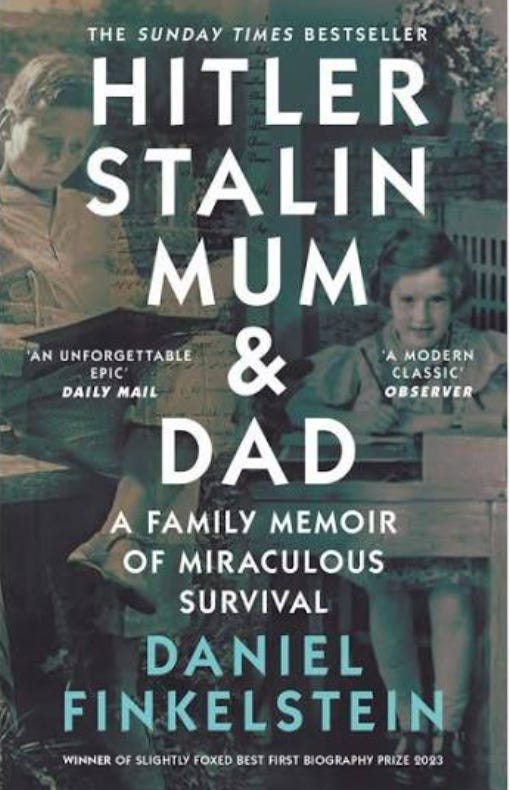
Finkelstein’s father, Ludwig, was born into an affluent family in Lwow, Poland (now Lviv, Ukraine). However, the Molotov - Ribbentrop Pact brought this idyllic upbringing to an end. His father, Dolu, was arrested by the invading Soviet army and his whereabouts were withheld from Lusia and Ludwig. Shortly thereafter, Lusia and Ludwig themselves were arrested and forcibly exiled across the Soviet Union. Finkelstein recounts how his father would have almost certainly been killed working the land had it not been for Operation Barbarossa, which saw the Soviet Union ally with Britain and bring an end to the policy of forced deportations. That this barbaric policy has itself become something of a footnote of history is something Finkelstein has rightly sought to reverse in this book.
Speaking with Finkelstein, I am struck by so much of this poignant story and how quickly history is forgotten. Despite having studied history in university, I had never heard of the forced deportation policy undertaken by the Soviet Union under Stalin, which upended the lives of hundreds of thousands of Poles (among others). I was also struck by Finkelstein’s description of the impossible choices faced by Jews in areas such as Nazi-occupied Holland. Finkelstein recounted how many thought that Holland, as an ostensibly neutral country, was the safest place they could be. He shared how even his own grandparents, who dedicated their lives to fighting the Nazis, miscalculated which countries would be safe.
Later on, our conversation turned to contemporary British politics and the recent rise in anti-semitic incidents in the UK. In the space of the past few months alone, racially motivated attacks against British Jews have included the October 2025 Manchester synagogue attack, the March 2026 ambulance arson attacks, and the April - May 2026 Golders Green attacks.
Reading Finkelstein’s book and discussing contemporary politics with him drove home that the lessons of “never again” must truly never be forgotten.
NB - audience questions during the event included questions surrounding Israel / Palestine and allegations that Israel has committed genocide in Gaza.